

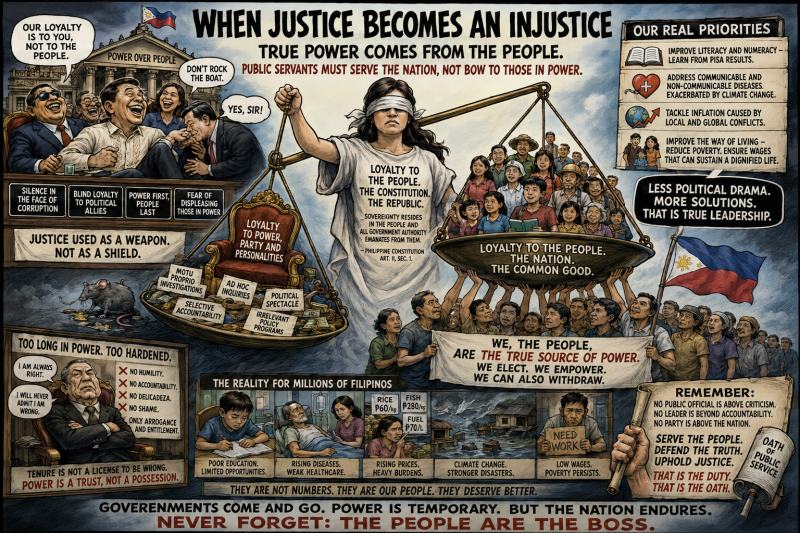
Justice is founded on the principles of fairness, equality, and accountability. Yet justice becomes an injustice when those entrusted to uphold it place loyalty to individuals, political parties, or those in power above their duty to the people. In a democracy such as the Philippines, public office exists not to serve personalities or factions, but to serve the entire Filipino nation.
Today, political divisions often lead citizens to view issues through the lens of party affiliation. Leaders are praised or condemned depending on which camp they belong to, and institutions are sometimes pressured to align themselves with those who hold power. However, justice loses its meaning when decisions are dictated by political convenience rather than by truth, fairness, and the rule of law.
The ordinary Filipino does not elect officials to become servants of presidents, vice presidents, political clans, or party leaders. Senators, representatives, judges, and other public servants take an oath not to protect the interests of a particular group, but to uphold the Constitution and safeguard the welfare of the Filipino people. Their allegiance must be to the Republic and to the citizens from whom all governmental authority originates.
When lawmakers remain silent in the face of wrongdoing because the accused belongs to their political camp, justice becomes an injustice. When officials blindly oppose measures simply because they come from a rival faction, justice becomes an injustice. And when public servants fear displeasing those who hold power more than disappointing the people they swore to serve, justice ceases to be a shield for the nation and becomes a tool of political survival.
Another troubling reality is that some elected officials, after spending many years in public office, become so accustomed to power that they lose the humility to recognize their own mistakes. Length of service does not confer infallibility. Experience should cultivate wisdom and accountability, not arrogance and entitlement. Yet there are those who, having occupied positions of authority for decades, become increasingly calloused to criticism and resistant to self-examination. Rather than acknowledge errors or accept responsibility, they cling to power and insist on their own righteousness, as though seniority itself grants moral superiority.
Such behavior is not only unbecoming of public servants; it is a strike against the Filipino virtue of delicadeza—that deeply rooted sense of honor, propriety, and moral responsibility that teaches one to act with humility and integrity. In Filipino culture, delicadeza means knowing when to admit mistakes, when to accept accountability, and when to place the welfare of the nation above personal pride and political ambition. Public office is a privilege entrusted by the people, not a possession to be guarded at all costs.
When leaders become too proud to acknowledge their failings, too comfortable with power to listen to criticism, and too convinced of their own righteousness to submit themselves to accountability, justice itself suffers. For justice demands not only the punishment of wrongdoing but also the humility to recognize it. Without such humility, public service gradually degenerates into self-service, and leadership becomes an exercise in preserving power rather than advancing the common good.
Equally disturbing is the tendency of some politicians to portray themselves as benevolent benefactors through the distribution of various forms of ayuda, as though such assistance were a personal gift bestowed out of generosity. Beneath their calloused faces and carefully cultivated images lies a fundamental truth that must never be forgotten: the money used for these programs does not come from their pockets. It comes from the taxes paid by ordinary Filipinos—from the salaries of workers who labor tirelessly each day, from entrepreneurs who sustain businesses despite economic hardships, and from citizens who faithfully fulfill their obligations to the State. Public funds are not instruments for political patronage, nor are they tools for cultivating personal loyalty. Assistance extended to the people is not an act of charity by politicians; it is a duty of government and a right of citizens. No public official should ever behave as though the people's money were their own, nor should any leader expect gratitude for merely returning to the people what rightfully belongs to them. To claim credit for distributing taxpayers' money while neglecting the deeper causes of poverty is not compassion—it is a distortion of public service and an affront to the dignity of hardworking Filipinos whose sacrifices sustain the nation.
Moreover, governance must rise above an excessive preoccupation with motu proprio investigations, ad hoc inquiries, and policy initiatives that generate political spectacle but fail to address the pressing realities confronting ordinary Filipinos. While accountability and legislative oversight are indispensable in a democracy, they should not come at the expense of more urgent national priorities. There are far more consequential issues demanding the attention of public officials: the alarming state of education, as reflected in the country's performance in international assessments of literacy and numeracy; the growing burden of communicable and non-communicable diseases aggravated by climate change and global warming; the rising prices of essential goods and services brought about by both local and international conflicts; and the daily struggle of millions of Filipinos whose incomes are increasingly insufficient to meet the demands of a dignified standard of living. These are not abstract figures confined to government reports. They are realities experienced by workers whose wages can no longer keep pace with inflation, by farmers and fisherfolk whose livelihoods are threatened by environmental and economic uncertainties, by students who continue to suffer from poor learning outcomes, and by families who remain trapped within or dangerously close to the poverty threshold.
Public office demands the wisdom to distinguish between what is politically expedient and what is genuinely essential. A government consumed by partisan disputes and performative politics risks neglecting the very people from whom it derives its authority. The measure of effective leadership is not the number of investigations conducted, nor the intensity of political rivalries, but the extent to which public institutions improve the lives, dignity, and future prospects of the Filipino people.
History has shown that power is temporary. Administrations come and go, political alliances change, and parties rise and fall. But the Filipino nation endures. Therefore, no public official should bow before personalities, regardless of which party they represent or which leader they support. Their highest obligation is not to any president, vice president, senator, governor, or political dynasty, but to the millions of Filipinos whose hopes, struggles, and aspirations they are entrusted to represent.
True justice demands independence from partisan interests. It calls upon leaders to have the courage to stand for what is right even when doing so is unpopular or politically costly. Justice is not measured by loyalty to those in authority, but by fidelity to the Constitution, adherence to the rule of law, and unwavering commitment to the common good.
In a democratic society, sovereignty resides in the people. Those who govern merely exercise authority entrusted to them by the citizens. Public officials are not masters of the nation; they are its servants. Their mandate comes not from political patrons or powerful allies, but from the Filipino people themselves.
Justice becomes an injustice when power is treated as something that flows from the top downward. In truth, the foundation of democracy teaches the opposite: power flows upward from the people. Therefore, regardless of political affiliation, ideology, or personal loyalties, every public servant must remember that the highest authority they answer to is not the powerful few, but the entire Filipino nation.
For in the end, governments exist for the people, not the people for the government. When those entrusted with power remember that they are servants rather than rulers, justice remains faithful to its purpose and democracy remains worthy of the sacrifices made by generations of Filipinos who fought to preserve it. As José Rizal reminded his countrymen, a nation loses its freedom not merely through the actions of tyrants, but through the complacency of those who forget their dignity and sovereignty. The Constitution itself affirms that sovereignty resides in the people and that all government authority emanates from them. Thus, no public servant, regardless of tenure, popularity, or political affiliation, should ever forget that the true source of power is not Malacañang, not Congress, nor any political dynasty, but the Filipino people themselves. When leaders cease to serve the nation and instead demand the nation's service to them, justice ceases to be justice—and becomes an injustice.
Add comment
Comments