

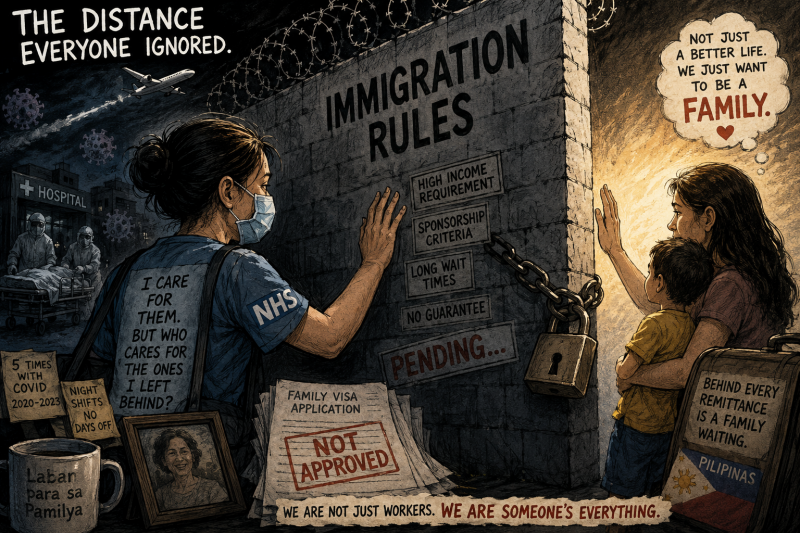
Nothing is harder than becoming an immigrant worker—or, as millions of Filipinos know all too well, an overseas Filipino worker.
My journey through distance began in 2020. Like many who leave home, I carried dreams that were never solely mine. They belonged to my family. Raised by a single mother, I knew early on that survival was not a matter of choice. It was a responsibility. There was never any guarantee that I could make it, but somehow, I convinced myself that I had to.
Then reality came.
I began working at the height of the COVID-19 pandemic. Hospitals became battlefields, and death became an unwelcome companion. I witnessed elderly patients take their last breaths, often without the comforting presence of loved ones. No one was truly safe—not even those entrusted to care for the sick.
Getting sick while living alone in a foreign country was a different kind of suffering. There were nights when I counted seconds, minutes, and hours, hoping that morning would still come. There were moments when having COVID itself felt like a respite, because it meant being allowed to rest. Between 2020 and 2023, I contracted the virus five times. Those years, when the pandemic was at its worst, tested not only my body but also my spirit.
Thankfully, vaccines arrived, and life endured. I survived.
But survival has its own loneliness.
No amount of home-cooked kare-kare, sinigang, lumpia, or buko salad can truly replace the comfort of home. You can recreate the taste, but not the feeling. There is something irreplaceable about knowing that, after a long day's work, your family is only a room away and not thousands of miles across the sea.
And because dreams are expensive, one learns to work as though tomorrow does not exist.
Like many migrant workers, I chased every opportunity—overtime, enhancements, night shifts—believing that every extra pound earned brought me closer to a better future. The rewards were tangible, but so were the consequences. Sleepless nights became routine. High blood pressure followed. Fatigue became a constant companion. Yet, the mindset remained unchanged: keep fighting, because the family depends on you.
Today, I am no longer just a son carrying responsibilities. I am now a husband carrying hopes.
My wife and I were married in 2025. We had little time together, choosing to legalize our union first, believing that love could patiently endure distance. Even now, I continue to hope that my work as a nurse will eventually allow me to bring her here. But the path is far from easy. Immigration rules, financial requirements, and countless uncertainties have turned what should be a simple aspiration—the right to build a family—into a long and painful struggle.
And this raises a question that deserves more than a passing thought.
Why is it that immigrant workers who have dedicated years of service are often denied the opportunity to live with the very people they sacrifice for?
Healthcare workers, particularly those serving within the National Health Service, are celebrated during times of crisis. They are called heroes when hospitals are overwhelmed. They are praised for their dedication and resilience. Yet once the applause fades, many are left to navigate lives marked by separation, loneliness, and prolonged uncertainty.
Public institutions rightly speak of compassion, inclusion, and the importance of family. But compassion cannot remain a slogan reserved for patients alone. It must also extend to those who provide care. Policies must recognize that workers are not merely units of labor or names on payrolls. They are husbands, wives, sons, daughters, fathers, and mothers whose greatest aspiration is not wealth, but togetherness.
This is not a complaint.
It is a plea for understanding.
For years, countless immigrant workers have accepted hardship with remarkable silence. They have missed birthdays, anniversaries, graduations, and even funerals. They have celebrated Christmas through video calls and embraced loved ones through screens. They have learned to smile during family gatherings they could only watch from afar.
And perhaps that is why society rarely notices their pain.
Distance has become so ordinary that people have forgotten it hurts.
Behind every remittance sent home is a sacrifice seldom acknowledged. Behind every success story is loneliness that rarely makes headlines. And behind every smiling photograph posted online is a longing that words can hardly describe.
My prayer remains simple.
May the day come when I no longer fall asleep with only a pillow beside me, but with the family I have worked so hard to build. May the sacrifices of migrant workers not only be praised but also understood. And may policies become kinder to those who have already given so much.
Because for far too long, there has been a distance that everyone has learned to live with—
and a distance that everyone has ignored.
Add comment
Comments