

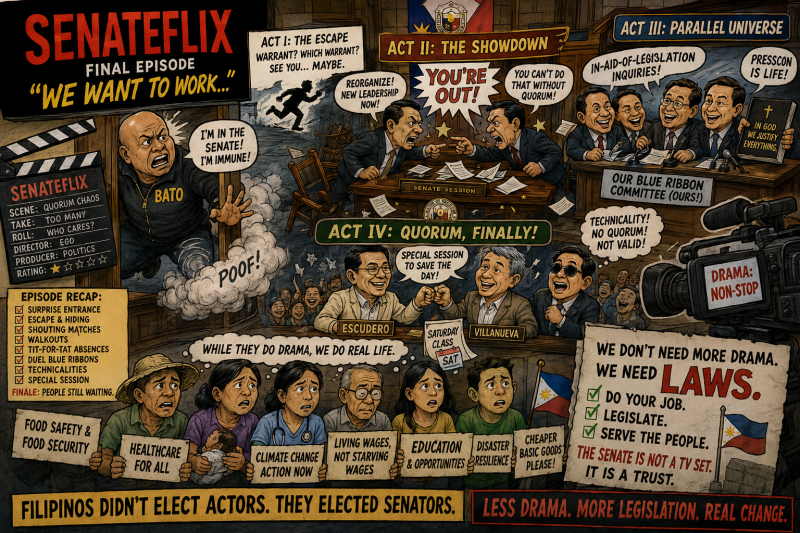
“We Want to Work…”
Well, well, well. As the curtains appear to fall on yet another season of Senateflix, perhaps it is only fitting to revisit the plot twists that transformed the country's highest legislative chamber into a stage more suited for prime-time drama than for public service.
The series began with an unexpected appearance by Senator Ronald “Bato” dela Rosa on May 11. What should have been an ordinary legislative day quickly resembled the opening sequence of an action film. The Senate Hall became the setting for hurried movements and heightened tension, as reports surfaced that agents of the National Bureau of Investigation were prepared to implement an arrest warrant against the senator in connection with allegations arising from the bloody anti-drug campaign.
The former police chief, once tasked with enforcing the law, found himself seeking refuge from its reach. Surrounded by allies from the majority bloc, he even invoked parliamentary privileges and requested to remain within the confines of the Senate building, effectively turning the institution into something it was never meant to be—a sanctuary from accountability. He stayed for several days, before disappearing as suddenly as he had arrived. Prior to his brief stay, his camp had sought relief from the Supreme Court in hopes of restraining actions connected to the International Criminal Court proceedings, but such efforts proved unsuccessful. Rumors swirled about who facilitated his departure, while authorities appeared caught between legal ambiguities and political sensitivities. After the dust settled, silence followed.
Then came June 3.
In the aftermath of the now-infamous confrontations within the Senate premises, another act unfolded. Amid the commotion, shouting matches, and near-physical altercations, one could almost imagine stunt coordinators waiting backstage. The atmosphere was less reminiscent of sober deliberation and more akin to a reality television special. Missing only were the cameras and dramatic background music.
The conflict soon shifted from personalities to positions. Members of the minority bloc pushed for a reorganization and the election of a new Senate leadership. Former Senate President Alan Peter Cayetano stood firm, rallying his allies behind the existing order. In response, the minority staged a walkout.
But politics, much like drama, thrives on irony.
When the minority returned to the session hall, it was the majority bloc that was nowhere to be found. Tit-for-tat politics replaced statesmanship. Some lawmakers argued that should such circumstances persist, a new leadership could be elected under the doctrine established in Avelino v. Cuenco. Thus emerged Senator Win Gatchalian as acting Senate President and President Pro Tempore. Yet the Cayetano bloc dismissed the move, citing the lack of quorum—a technical requirement that, in layman's terms, determines whether legislative actions possess any legal validity at all.
The result? Two Blue Ribbon Committees, one subcommittee, competing claims to legitimacy, and enough confusion to leave resource persons wondering which summons carried authority. Malacañang eventually recognized Gatchalian's bloc as legitimate, yet the old majority remained unmoved. Parallel investigations proceeded. Separate press conferences followed. And somehow, amid all the political posturing, even the Almighty was invoked to justify conduct that many observers found wanting in delicadeza.
Eventually, through the intervention of Senators Francis Escudero and Joel Villanueva, a quorum was finally assembled—though not without the calling of a special session. It was akin to students being required to attend Saturday classes simply to make up for lessons missed because they spent the week arguing among themselves.
What a colossal waste of time.
I recall writing on social media that the Filipino people deserve better priorities from their lawmakers. Some were quick to lecture me about legal procedures and constitutional nuances. Fair enough. Laws and jurisprudence matter, and every constitutional process deserves respect. But understanding the law does not require one to abandon common sense.
The people's plea has never been complicated.
Do your jobs.
Legislate.
Pass measures that improve the lives of ordinary Filipinos.
Craft laws that address food security and food safety in an era increasingly threatened by climate change. Strengthen healthcare systems as the country grapples with both communicable and non-communicable diseases. Pursue wage policies that keep pace with rising costs of living. Address education, agricultural productivity, and disaster resilience. In other words, govern.
Because while senators quarrel over committee chairmanships and leadership struggles, families continue to worry about putting food on the table. Farmers continue to endure unpredictable weather. Healthcare workers remain overburdened. Wages continue to lag behind inflation. These are realities far more pressing than the theatrics unfolding within the Senate halls.
Perhaps what is most frustrating is that the actors themselves have repeatedly declared, “We want to work.”
Very well.
Then work.
Not for television ratings. Not for political survival. Not for the next election cycle.
Work for the people who sent you there.
The Senate is not a film studio. It is not a safe house. It is not an arena for endless ego contests.
It is a constitutional institution entrusted with the solemn duty of crafting laws and exercising oversight in the interest of the nation.
And if this truly is the final episode of Senateflix, one can only hope that the next season features less drama, fewer plot twists, and more governance.
Because the Filipino people did not elect actors.
They elected senators.
Add comment
Comments