

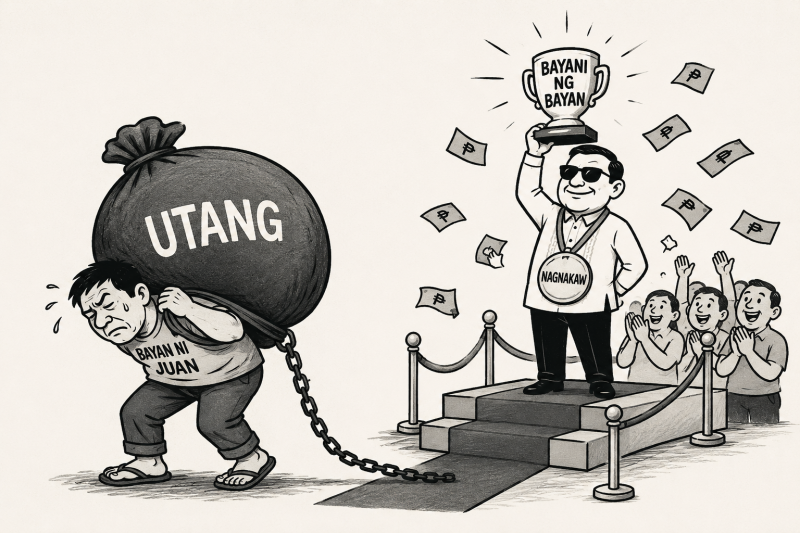
“…nabaon sa utang ang bayan ni Juan, ngunit ang nagnakaw pa ang pinararangalan.”
-G.Granada, “Holdap”
It comes as no surprise to millions of Filipinos that corruption—whether microscopic or grandiose—has become a chronic affliction of the nation. We have learned to live with headlines of misuse of public funds, patronage politics, and promises recycled every election season. Yet the greater tragedy is not merely the persistence of corruption itself, but the collective acceptance that it is simply part of our national character.
Everyone speaks of change. Politicians campaign on it, citizens demand it, and generations continue to hope for it. But how can genuine change take root when the country itself remains fragmented by divisions that have become increasingly normalized? Regionalism has become more pronounced. The provinces are pitted against "Imperial Manila," while communities and identities are manipulated to create camps of "us versus them." Frankly, I do not understand it. The enemy is not the people engaged in the fight; the enemy is the one quietly benefiting while everyone else is distracted by the conflict.
Historically and geographically, the Philippines has always been an archipelago—a collection of islands separated by vast waters. Geography, however, should never have condemned us to political fragmentation. Yet in many ways, it has. We have become a nation divided by competing regional aspirations, localized political interests, and loyalties that often supersede the national good.
Think about it. We have a central government, but many citizens hardly pay attention to national policies unless they come packaged with subsidies, assistance, or immediate personal benefits. Such a political culture did not emerge overnight. It created fertile ground for the rise of political dynasties, where families became institutions and positions of public service evolved into hereditary privileges. To be fair, not all political clans are inherently destructive; some have contributed to the progress of their localities. But many have transformed governance into a matter of preserving power rather than promoting development.
The result is a dangerous cycle. Communities become dependent on personalities rather than institutions. Elections turn into contests of familiarity instead of competence. Public office becomes an inheritance rather than a responsibility. Consequently, corruption is no longer viewed as an aberration; it becomes merely another chapter in the routine of governance.
Recently, I listened to a song that touched on a socio-political issue. One line struck me deeply: justice is a value system that is culturally learned. In other words, people are taught what is right and what is wrong through the norms they continuously experience. If individuals become accustomed to injustice, they eventually learn to tolerate falsehood. Worse, they begin to accept lies as truth and regard abnormality as normal.
And perhaps this is the most dangerous form of corruption—not the theft of billions, but the gradual erosion of moral standards. A society does not collapse overnight. It declines when citizens stop being outraged. It weakens when lies become acceptable, when mediocrity becomes sufficient, and when injustice becomes ordinary.
This explains why corruption survives regardless of administrations. The names change, the slogans evolve, and the colors of political banners differ, yet the machinery remains intact because the culture that sustains it remains untouched. We have become experts at changing leaders, but we have yet to master the harder task of changing ourselves.
True change cannot be achieved by electing messiahs every six years. It cannot be accomplished through blind loyalty to personalities, nor by reducing national discourse into regional rivalries and partisan spectacles. A divided people can never confront a common enemy because they are too busy confronting one another.
Perhaps the greatest victory corruption has achieved is convincing Filipinos that their fellow Filipinos are the enemy. While we argue over regions, dialects, and political colors, those who thrive on division continue to prosper. They do not need to silence the people; they simply need to keep them fighting among themselves.
And so, the challenge before us is not merely to replace officials, but to rebuild citizenship. We need institutions stronger than surnames, principles stronger than personalities, and a sense of nationhood greater than regional pride. The Philippines will always consist of thousands of islands, but being an archipelago should never mean being a fractured people.
Because in the end, corruption is not defeated by outrage alone. It is defeated when truth becomes non-negotiable, when justice becomes habitual, and when Filipinos finally realize that they rise or fall not as Tagalogs, Bisayans, Ilocanos, or Mindanaoans—but as one people.
For if we continue to mistake one another for the enemy, then the corrupt need not conquer this nation. We would have already done the job for them.
Add comment
Comments