

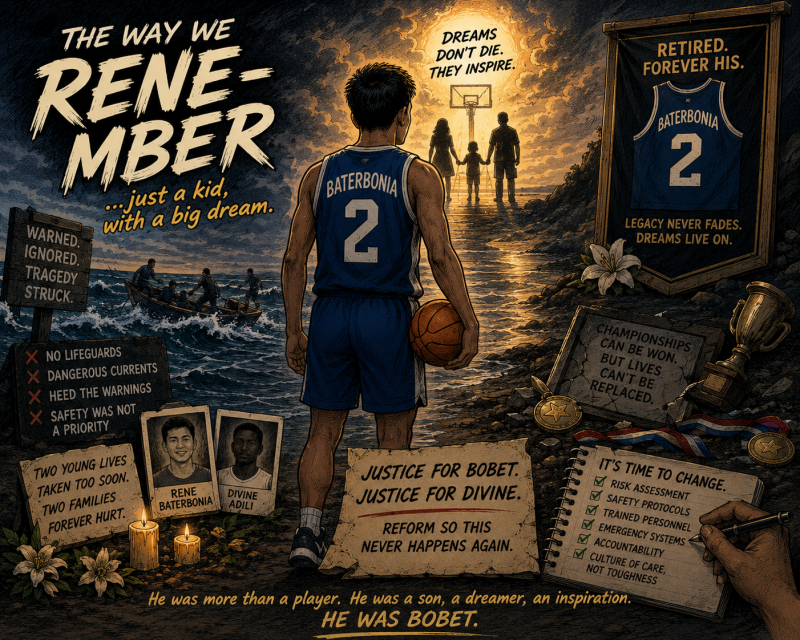
"...just a kid with a big dream."
Born without the comfort of privilege, sports icon Rene “Bobet” Baterbonia was, first and foremost, a young boy from San Nicolas, Talacogon, Agusan del Sur. Basketball was not merely a game for him; it was an opportunity. It was his ladder out of poverty, his gift to his family, and his promise to those who believed in him.
That promise, however, was cut short on June 8 in Dipaculao, Aurora.
Alongside fellow Ateneo Blue Eagles player and Nigerian athlete Divine Adili, Bobet lost his life in what was initially described as an accident. But as the days unfolded, so did the troubling questions. According to the Criminal Investigation and Detection Group of the Philippine National Police (CIDG-PNP), the incident has since been viewed through the prism of homicide and hazing. Players past and present have submitted affidavits. Emotions have spilled over in public. Guilt has been expressed. Yet grief, no matter how genuine, does not substitute for truth, and remorse does not exempt anyone from accountability.
For all the tears shed and condolences offered, one painful reality remains: two young men are gone.
Reports that surfaced from both mainstream and social media revealed that warnings had allegedly been given by the management of the resort where the team was staying. The sea conditions were dangerous. The currents were strong. The waters were deemed unsuitable for the activities being conducted. The instructions, according to these reports, were simple and straightforward—stay away from the water.
But tragedy often begins when warnings are mistaken for inconveniences.
Equally disturbing were reports that no lifeguards were present in the area at the time. The coaching staff later clarified that there were personnel tasked to ensure the players' safety and that there was someone assigned for first aid. Yet such explanations only invite a more uncomfortable question.
Is that really enough?
A university that prides itself on excellence should understand that excellence extends beyond championships, banners, and winning traditions. Excellence must include preparation for emergencies, clear risk assessments, and uncompromising safety protocols. The lives of student-athletes cannot be left at the mercy of improvisation and good intentions.
After all, first aid is not a substitute for prevention.
This tragedy has exposed more than the vulnerability of two young men. It has exposed the culture of excessive toughness that often surrounds competitive sports—the dangerous belief that limits are meant to be ignored, warnings are signs of weakness, and risks are badges of courage.
But nature does not negotiate.
Neither do raging waters.
Perhaps the greatest irony is that institutions spend millions developing champions, yet sometimes fail to invest enough in protecting them. Universities recruit talent, celebrate victories, and immortalize athletes in history books. But what value do trophies possess if the very lives behind them are treated as expendable?
No championship banner is worth a human life.
No tradition is worth a funeral.
No culture of toughness should ever demand silence in the face of preventable danger.
Justice, therefore, should not merely seek to punish those who may have been responsible. Justice must also compel reforms. Sports programs across the country must revisit their protocols. Schools must strengthen their emergency preparedness. Authorities must enforce standards without compromise. Because if lessons remain unlearned, then grief itself becomes meaningless.
For what happened to Rene Baterbonia and Divine Adili should never happen again.
And so, amid the noise of investigations and the search for accountability, one question remains:
How do we remember Rene?
Bobet was more than a recipient of the Datu Lipus Makapandong Award, Agusan del Sur's highest provincial honor. He was more than an Agusan del Sur sports icon. He was more than his Most Valuable Player citations, his medals in the Palarong Pambansa, and the national and international competitions where he proudly represented his province and country.
Awards are easy to remember.
People are harder to forget.
To his family, he was a son.
To his hometown, he was a source of pride.
To aspiring athletes, he was proof that greatness can emerge from the humblest beginnings.
And to those who truly knew him, Rene Baterbonia was not defined by trophies, statistics, or newspaper headlines.
He was simply a kid with a big dream.
A dream to lift his family from poverty.
A dream to give back.
A dream that reached far beyond himself.
Perhaps that is the way we should RENE-member him.
Not through the circumstances of his death, but through the meaning of his life.
Not through the tragedy that took him away, but through the hope that he embodied.
Because long after the investigations are concluded, long after the headlines fade, and long after memories of this controversy grow distant, one image should remain.
A young boy from San Nicolas, Talacogon, Agusan del Sur, chasing a basketball with nothing but faith, perseverance, and dreams bigger than his circumstances.
Just a kid.
With a big dream.
And perhaps that is what hurts the most.
Not because the dream ended.
But because it had only just begun.
Add comment
Comments