

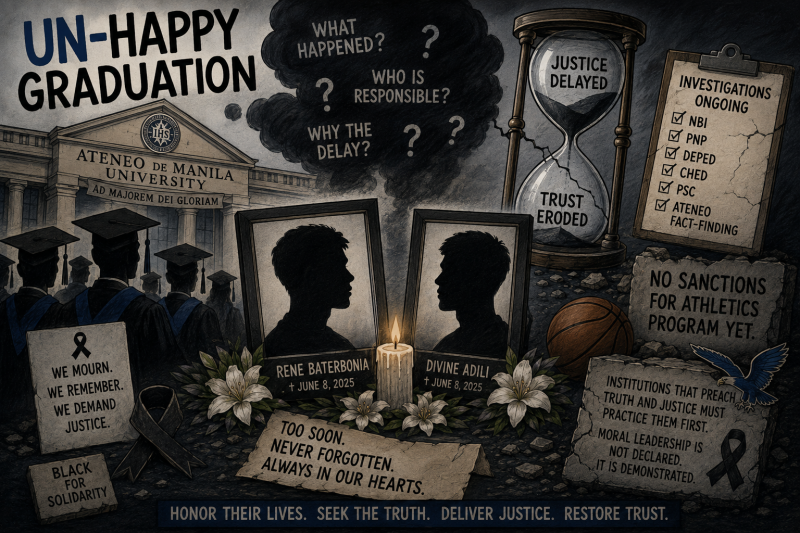
On June 19, the Ateneo de Manila University commenced its graduation ceremonies under a cloud of grief and uncertainty. What is usually a day of celebration became one marked by mourning, reflection, and unanswered questions. The tragedy that unfolded on June 8 in Dipaculao, Aurora, resulting in the deaths of Blue Eagles players Rene Baterbonia and Divine Adili, cast a long shadow over the occasion.
In his opening remarks, Ateneo President Fr. Roberto “Bobby” Yap, SJ acknowledged the pain felt across the community and offered an apology for what many perceived as the administration’s delayed response to the incident. His words sought to reassure students, parents, alumni, and faculty that the university remains committed to uncovering the truth behind the events that led to the deaths of two young athletes whose futures were filled with promise.
To its credit, the university has begun conducting its own fact-finding investigation alongside inquiries being undertaken by the National Bureau of Investigation, the Philippine National Police, and other concerned agencies, including the Department of Education, the Commission on Higher Education, and the Philippine Sports Commission. Yet for many observers, the question remains whether these efforts came swiftly enough to address the growing demand for accountability.
The repercussions have already reached the highest levels of Ateneo’s athletic program. The resignation of head coach Tab Baldwin and members of his coaching staff signaled the seriousness of the crisis. Their subsequent barring from participation in the University Athletic Association of the Philippines, based on the latest recommendations from the league’s organizing body, further underscored the gravity of the situation. However, while individual figures have already faced consequences, the broader athletics program has yet to receive any formal sanctions or institutional reprimand.
The tragedy has also reportedly shaken the confidence of current and prospective players. Speculation continues regarding the future of several athletes, including those who shared close ties with Baterbonia through their time at Ateneo de Davao and later Ateneo de Manila. Whether these rumors materialize into departures or transfers remains uncertain, but the emotional toll on the team and the wider athletic community is undeniable.
Beyond the basketball court, the incident has deeply affected the Ateneo community. Student councils and organizations encouraged the wearing of black armbands as a symbol of mourning and solidarity with the families of the victims. Vigils, tributes, and public expressions of grief have emerged across campus spaces and social media platforms. These gestures reflect not only sadness but also a collective call for justice and accountability.
Yet this tragedy raises a more uncomfortable question—one that extends beyond athletics and into the institution’s identity itself.
Historically, Ateneo de Manila has positioned itself as a moral voice in Philippine society. It has spoken against corruption, challenged abuses of power, criticized government failures, and advocated for justice in moments of national crisis. The university has often reminded the public of the values of truth, integrity, and accountability. Such positions have earned both admiration and criticism, but they have consistently reinforced Ateneo’s image as an institution willing to speak when principles are at stake.
That is precisely why many have been troubled by what they perceived as an initially muted response to this incident. Institutions that demand accountability from others must be equally willing to subject themselves to scrutiny. The standards Ateneo applies to society cannot be different from the standards it applies to itself. Moral credibility is not built through statements alone; it is sustained by action, transparency, and a willingness to confront difficult truths even when doing so is uncomfortable.
This moment therefore represents more than a crisis for the university’s athletic program. It is a test of institutional character. The public will not only judge Ateneo based on the findings of investigations but also on how it chooses to respond, reform, and learn from this tragedy. The university’s legacy will be shaped not by the fact that a crisis occurred, but by whether it demonstrated the courage to address it honestly and comprehensively.
For the families of Rene Baterbonia and Divine Adili, however, discussions about reputation and institutional accountability remain secondary. Their loss is immeasurable. No investigation, administrative action, or public apology can restore the lives that were cut short. What they deserve above all else is truth—complete, transparent, and unfiltered. They deserve justice that is not delayed, diluted, or obscured by technicalities.
As the graduation ceremonies proceeded, diplomas were awarded, photographs were taken, and celebrations continued. Yet beneath the applause lingered a sense of unfinished business. The Ateneo community celebrated achievement while carrying the burden of grief. It was, in many ways, an “un-happy” graduation—not because there was nothing to celebrate, but because there was also much to mourn.
For now, the most important task is neither assigning blame prematurely nor protecting institutions from criticism. It is remembering the lives of Rene Baterbonia and Divine Adili, honoring their aspirations, and ensuring that those responsible for any wrongdoing are held accountable. Only then can genuine healing begin. Only then can justice offer some measure of peace to the families left behind. And only then can Ateneo begin the difficult process of restoring the trust that this tragedy has shaken.
Add comment
Comments