

"Education is the most powerful weapon which you can use to change the world." — Nelson Mandela
There is a sound every school is meant to produce: the laughter of children in hallways, the chatter of friends during recess, the recitation of lessons in classrooms, and the applause that follows achievement. These are the sounds of learning, growth, and hope.
There is another sound that should never echo within school walls.
The sound of violence.
I was recently drawn into a Korean series on Netflix entitled Teach You a Lesson. The series follows students, teachers, parents, and government investigators confronting the growing epidemic of school violence. It paints a disturbing picture of what happens when institutions fail to protect the vulnerable and when cruelty becomes normalized among the young. The stories are fictional, but the problems are painfully real. Bullying, harassment, social exclusion, cyberattacks, and physical violence have become so prevalent that they have forced entire societies to confront an uncomfortable truth: schools are no longer automatically safe spaces.
South Korea knows this struggle all too well. Years of intense academic pressure, rigid social hierarchies, and the ever-expanding reach of social media have contributed to an environment where many students feel trapped between the need to succeed and the fear of humiliation. Some withdraw from school. Others suffer in silence. Some seek revenge. Others lose hope altogether.
As unsettling as these realities may seem, they are no longer distant stories from another country.
They are becoming our own.
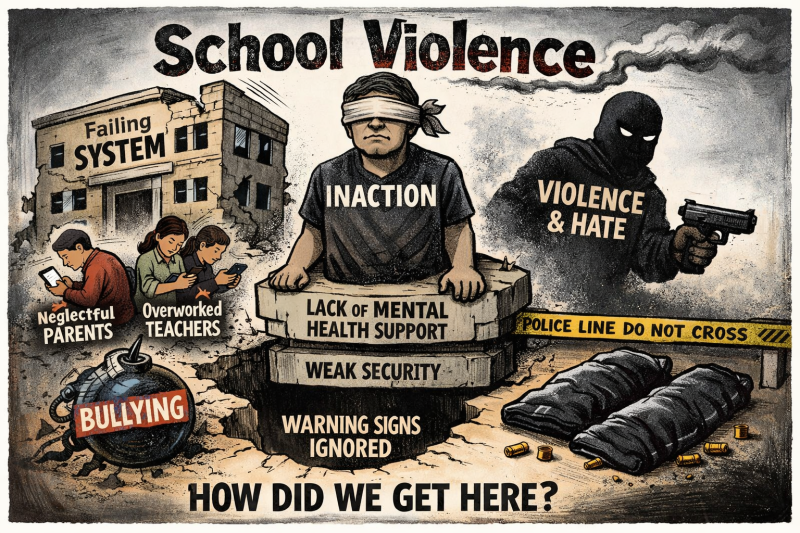
Recent reports of violence in Philippine schools have once again raised concerns over the safety of students inside educational institutions. Among the most disturbing incidents was a shooting in Tacloban City that claimed the lives of two students. Authorities have apprehended the suspects and investigations continue. Yet while attention remains focused on the crime itself, a larger and more difficult question lingers:
How did we arrive here?
How did schools—institutions designed to shape futures—become places where lives are destroyed?
The answer is not simple. There is no single cause behind school violence. It is the product of multiple failures occurring simultaneously, often unnoticed until tragedy strikes.
One of the most significant factors is the growing culture of competition.
Education was meant to be a pathway toward self-improvement. Increasingly, however, it has become a battlefield of rankings, honors, achievements, and expectations. Students are taught from an early age that success must be measured against the accomplishments of others. The pressure to excel academically, socially, and even financially creates an environment where many young people begin to view their peers not as companions but as competitors.
For some, the pressure becomes unbearable.
Those who struggle academically may become targets of ridicule. Those who excel may become objects of resentment. Students who fail to conform to expectations often find themselves isolated. In a system obsessed with performance, empathy frequently becomes collateral damage.
Equally concerning is the persistence of bullying itself.
For decades, bullying has been dismissed as a normal part of growing up. Many adults continue to describe it as harmless teasing, youthful mischief, or character-building adversity. Such thinking is not merely outdated—it is dangerous.
Bullying is not a rite of passage.
It is abuse.
The scars it leaves are not always visible. Victims often carry feelings of fear, shame, anxiety, and worthlessness long after the incidents themselves have ended. Some lose confidence in their abilities. Others lose trust in the institutions that were supposed to protect them. In severe cases, the psychological damage can follow them well into adulthood.
What makes the problem even more alarming today is that bullying no longer ends when classes are dismissed.
The rise of social media has created an environment where victims can be targeted twenty-four hours a day. A cruel remark whispered in a classroom can become a viral post within minutes. Rumors spread faster than facts. Embarrassing photos are shared without consent. Anonymous accounts provide cover for harassment. Entire online communities can participate in the public humiliation of a single individual.
The schoolyard has become digital.
And unlike a physical playground, there is often nowhere to escape.
The effects of cyberbullying can be devastating because victims carry their tormentors in their pockets. Home, once considered a refuge, is no longer immune. The abuse follows students wherever they go, creating a sense of constant vulnerability that many adults struggle to understand.
Another factor that deserves attention is the erosion of meaningful human connection.
Despite living in the most connected era in history, many young people are increasingly isolated. Conversations are replaced by screens. Validation is measured through likes and shares. Genuine friendships are often overshadowed by online popularity. In such an environment, empathy becomes more difficult to cultivate.
It is easier to hurt someone when their pain feels distant.
It is easier to mock someone when the audience rewards cruelty.
It is easier to ignore suffering when everyone else appears to be doing the same.
Perhaps the most troubling aspect of school violence is that it rarely occurs without warning.
There are often signs.
The student who suddenly withdraws from classmates.
The child whose grades unexpectedly plummet.
The teenager who stops participating in activities they once enjoyed.
The young person whose cries for help are disguised as anger, silence, or despair.
Too often, these warning signs are ignored.
Teachers assume parents will intervene. Parents assume schools are monitoring the situation. Classmates assume someone else will help. As responsibility shifts from one person to another, vulnerable students are left alone.
Then tragedy happens.
And everyone asks why.
The truth is that preventing school violence requires more than reactive measures. It requires a cultural shift in how society views bullying, mental health, and student welfare.
Schools must establish stronger anti-bullying programs that go beyond slogans and posters. Teachers must receive adequate training to identify early warning signs. Guidance counselors and mental health professionals must be made more accessible. Reporting systems must protect victims rather than expose them to further humiliation. Parents must remain actively engaged in their children's emotional development rather than focusing solely on academic performance.
Most importantly, students must be taught that strength is not measured by dominance but by compassion.
The greatest lesson a school can teach is not found in textbooks.
It is humanity.
The tragedy in Tacloban should not merely be another headline that fades from public memory after a few news cycles. It should serve as a national reminder that violence is rarely born overnight. It grows in environments where bullying is tolerated, where suffering is ignored, and where silence becomes easier than intervention.
A society that waits for gunshots before addressing bullying has already waited too long.
Schools should echo with dreams, not fear.
With curiosity, not intimidation.
With encouragement, not humiliation.
And certainly never with the sound of violence.
Because the moment gunfire becomes part of a school's memory, education has already suffered its greatest failure.
Add comment
Comments