

What does it say about a community when thousands pause their daily routines—not for a festival, a political rally, or a public celebration—but simply to accompany one of their own on his final journey?
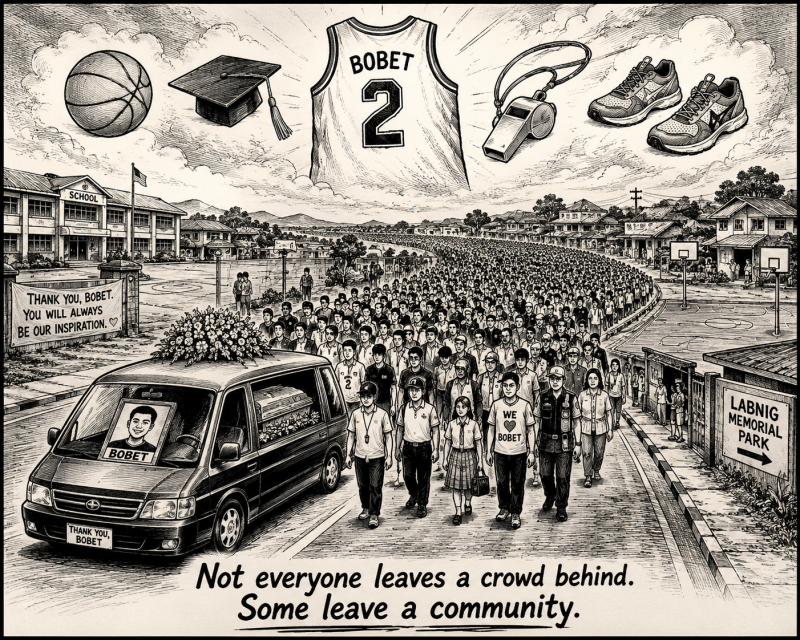
On June 24, 2026, the municipality of Talacogon, Agusan del Sur witnessed a scene few communities ever experience. Streets that normally carried the rhythm of everyday life became avenues of remembrance as family members, friends, athletes, students, government officials, and ordinary citizens gathered to accompany Rene Clert “Bobet” Baterbonia to his final resting place at the New Talacogon Memorial Park. The funeral mass and interment marked the conclusion of days of mourning that drew visitors from across the country, all united by a single purpose: to honor a life that had touched countless others.
Yet the significance of that day extended far beyond funeral rites and ceremonial farewells. It revealed a truth often overlooked in a society fascinated by statistics, titles, and achievements. Greatness is not measured solely by trophies won, records broken, or accolades received. Greatness is measured by the lives one influences and the people who choose to stand beside them when the final whistle has blown.
Bobet's story was never merely about basketball. It was about possibility. He embodied the belief that a young athlete from a small town could dream beyond geographical boundaries and compete on larger stages. His journey resonated with countless young Filipinos who saw themselves in him—children practicing on dusty courts, students balancing academics and athletics, and dreamers determined to overcome circumstance through perseverance and hard work.
As his coffin made its final journey through Talacogon, the overwhelming turnout spoke volumes. No one was compelled to attend. The crowd came because they felt connected to his story. In an era where public attention is often fleeting and admiration can be manufactured through publicity, the thousands who lined the roads demonstrated that genuine respect cannot be bought or staged. It is earned through character, humility, perseverance, and the positive impact one leaves on others.
The interment also served as a reminder that success is never an individual accomplishment. Behind every athlete stands a family that sacrifices, coaches who guide, teammates who struggle alongside them, and a community that believes in them long before the spotlight arrives. As Talacogon bid farewell to Bobet, it was not merely grieving the loss of a promising athlete. It was mourning a son, a brother, a teammate, a friend, and a symbol of local pride.
Perhaps the most unforgettable moment came not during the procession, nor during the prayers, but in the final moments before the casket was closed.
As family members gathered around Bobet's coffin, grief could no longer be contained by silent tears. From the depths of a mother's anguish came a cry that pierced the solemnity of the occasion—a cry carrying the unbearable weight of loss, unanswered questions, and a yearning for justice. It was the kind of cry that only a parent who has buried a child can utter.
For those who heard it, the cry seemed to transcend the walls of the funeral hall. It sounded less like a farewell and more like an appeal to the conscience of those left behind. It was a plea not to look away, not to forget, and not to allow the circumstances surrounding his death to disappear beneath the passage of time and the comfort of indifference.
In that moment, the closing of the casket symbolized more than the end of a life. It marked the beginning of a collective responsibility. The lid may have closed upon Bobet's earthly journey, but it opened a challenge to every witness: whether they would remain passive observers or become advocates for truth, accountability, and justice.
The mother's cry became the final voice heard before farewell. Its power lay not in anger, but in purpose. It was not a call for vengeance. It was a call for answers. A call that echoed through Talacogon and beyond, reminding everyone that while a young man's life has ended, the pursuit of justice must not be buried with him.
As the final prayers were offered and mourners slowly dispersed, another question emerged: What comes next?
Funerals provide closure, but they do not erase the realities grieving families face once the crowds have gone home. For the Baterbonia family, the interment was not the conclusion of their journey. It was the beginning of a difficult chapter marked by healing, adjustment, and the challenge of moving forward without a son and brother whose presence had become central to their lives.
Amid the sorrow, however, signs of hope and solidarity continue to emerge. Even after Bobet was laid to rest, various institutions and individuals expressed their commitment to supporting the family. These gestures demonstrate that compassion should not end at the cemetery gates. True sympathy is measured not only by attendance during a wake or funeral, but by the willingness to stand beside a family long after public attention fades.
Among these gestures was the offer of a condominium unit from the National Housing Authority, intended to provide the family with a place to stay while in Davao City. The location carries special significance, situated near the school that helped shape Bobet's academic and athletic aspirations and where his siblings continue their own educational journeys. More than a housing offer, it represents continuity—a bridge between cherished memories and future opportunities.
Additional support has come from members of the private sector through commitments of furnishings and household necessities. While no amount of material assistance can ever compensate for the loss of a loved one, such acts reflect a sincere desire to ease the burdens carried by those left behind.
Yet beyond donations, housing assistance, and public tributes lies a greater obligation. The outpouring of support should not merely preserve Bobet's memory; it should help secure the future of the family he left behind. The greatest tribute to his life may not be found in monuments, ceremonies, or speeches, but in ensuring that those he loved are given the opportunity to rebuild, recover, and pursue the dreams that he once carried.
There is also a broader lesson hidden within the sea of mourners that filled Talacogon's streets. Communities often find their greatest unity in moments of tragedy. The challenge is sustaining that unity after the headlines disappear and the ceremonies conclude. The tears, prayers, tributes, and expressions of admiration will mean little if they end at the cemetery gates.
The most meaningful way to honor Bobet is not through social media posts or grand declarations. It is through living the values he represented—discipline, humility, perseverance, and service to others. It is through supporting aspiring young athletes, strengthening communities, and ensuring that opportunities remain available to those who dare to dream.
As the soil settled over his grave, Talacogon was not merely laying an athlete to rest. It was entrusting a legacy to the next generation. The thousands who walked beside him on his final journey were, knowingly or not, making a promise—that the dreams he carried would not be buried with him.
For some, a funeral marks an ending.
For Talacogon, it felt like the beginning of a responsibility.
A responsibility to remember. A responsibility to support those left behind. A responsibility to seek truth and justice. And above all, a responsibility to ensure that the story of Rene Clert “Bobet” Baterbonia continues to inspire long after the cheers have faded, the crowd has gone home, and the court has fallen silent.
For while the final whistle has been blown, the legacy it leaves behind continues to echo.
Add comment
Comments