

It is deeply troubling to think that since the Tacloban School Shootings on June 22, 2026, reports of students and schools becoming involved in acts of violence and criminal behavior have continued to surface. What should have been sanctuaries of learning, growth, and friendship are now being confronted with disturbing realities that challenge the very foundation of our education system.
The Department of Education (DepEd), together with law enforcement agencies and other concerned institutions, has begun implementing measures to address these concerns. Security protocols, intervention programs, and discussions on mental health and student discipline have been placed under review. But the question remains: are these efforts enough to assure parents, guardians, and the Filipino people that our children are truly safe inside the very halls that are supposed to shape their future?
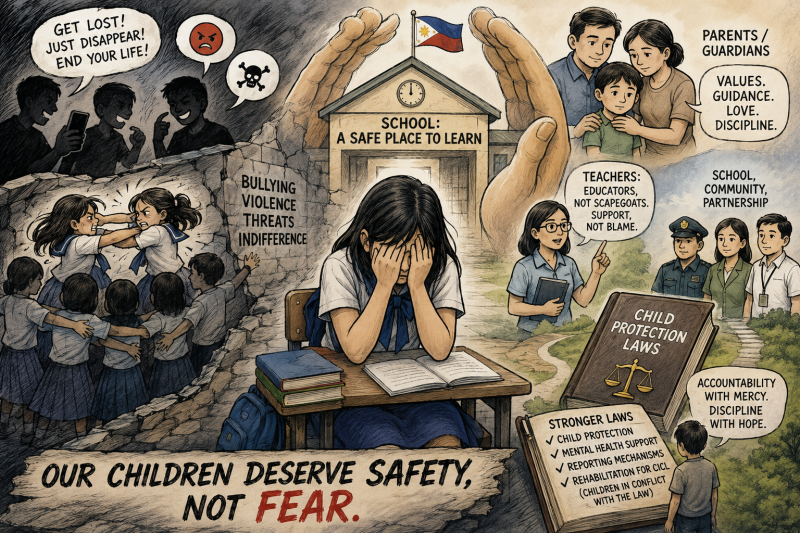
During my research and personal observations on social media, I encountered a post from a friend who expressed deep pain and frustration after her niece became a victim of cruel and threatening messages from another student. What began as a disagreement eventually turned into a series of hurtful remarks, including statements telling the young girl to disappear and end her own life.
The disturbing part was not only the words themselves, but the reality behind them. These were not adults engaged in a serious dispute; they were minors—students who are still expected to be guided, disciplined, and protected. The ease with which threats of harm and death were communicated reflects a deeper problem: a growing lack of empathy, emotional regulation, and accountability among some young people.
Another incident that caught public attention involved a video circulating online from a public secondary school in my hometown. The footage showed a group of students forming a human barrier while two other students engaged in a physical altercation. The incident eventually reached the attention of education authorities, prompting disciplinary action and intervention.
These incidents raise uncomfortable but necessary questions: What is happening inside our schools today? Are we witnessing a failure of supervision, discipline, and child protection? Where do these behaviors originate, and how can we prevent them before they escalate into tragedies?
Schools are undeniably responsible for creating a safe environment for students. Children spend a significant portion of their formative years inside classrooms, making educational institutions a crucial space for their protection, development, and guidance. However, we must also recognize that schools cannot carry the burden of raising children alone.
The first institution of discipline, values, and accountability is the family.
Too often, society expects schools to repair every behavioral problem a child brings into the classroom. Teachers are asked to become educators, counselors, social workers, and even substitute parents. Yet behind every student is a home environment that plays an essential role in shaping their character.
Values such as honesty, respect, empathy, self-control, and responsibility must begin at home before they are reinforced in school. Parenting cannot be outsourced entirely to teachers. Raising a child is not merely about providing material needs; it is about nurturing a person who understands the consequences of their words and actions.
However, while accountability must exist, we must also acknowledge that children involved in these incidents are still children. This is where the government must strengthen and reassess existing child protection policies, particularly concerning Children in Conflict with the Law (CICL).
The goal of the juvenile justice system should not only be punishment but rehabilitation. A child who commits an offense must face appropriate consequences, but society must also ask why that child reached that point. Was there a failure in guidance, mental health support, family supervision, community intervention, or access to proper counseling?
Protecting children does not mean shielding them from accountability. True child protection means correcting harmful behavior while giving young offenders the opportunity to change. Laws and policies must evolve to address the realities of today’s generation, including cyberbullying, online threats, psychological abuse, and acts of violence occurring among minors.
The government, as the steward of the public education system, must also ensure that schools are equipped with adequate resources. Strengthening student welfare programs, increasing access to guidance counselors, improving reporting mechanisms, and establishing stronger partnerships between schools, families, and communities are necessary steps toward creating safer learning environments.
But let us also be clear: teachers should not become the scapegoats for every failure within the education system.
With the overwhelming responsibilities placed upon educators—from teaching multiple subjects to preparing reports, managing classrooms, and fulfilling administrative duties—it is unfair to place every behavioral issue solely on their shoulders. Teachers are not the enemy. They are among the strongest pillars of society, entrusted with the responsibility of guiding the next generation.
If there is a fracture in the system, we must examine the entire structure—not simply blame those standing inside the classroom.
A school should never become a place where fear replaces curiosity, where threats replace conversations, or where violence replaces understanding. The classroom must remain a sanctuary of learning, not a reflection of the conflicts we fail to address outside its walls.
The safety of our children is not merely a DepEd concern. It is a national responsibility. It requires stronger laws, responsible parenting, accountable communities, and institutions willing to act before another tragedy forces us to ask the same questions again.
Because when a child walks into a school, they should carry books, dreams, and hopes for the future—not fear of becoming the next victim of a system that failed to protect them.
Add comment
Comments